
EPPO Alert List – Senecio deltoideus
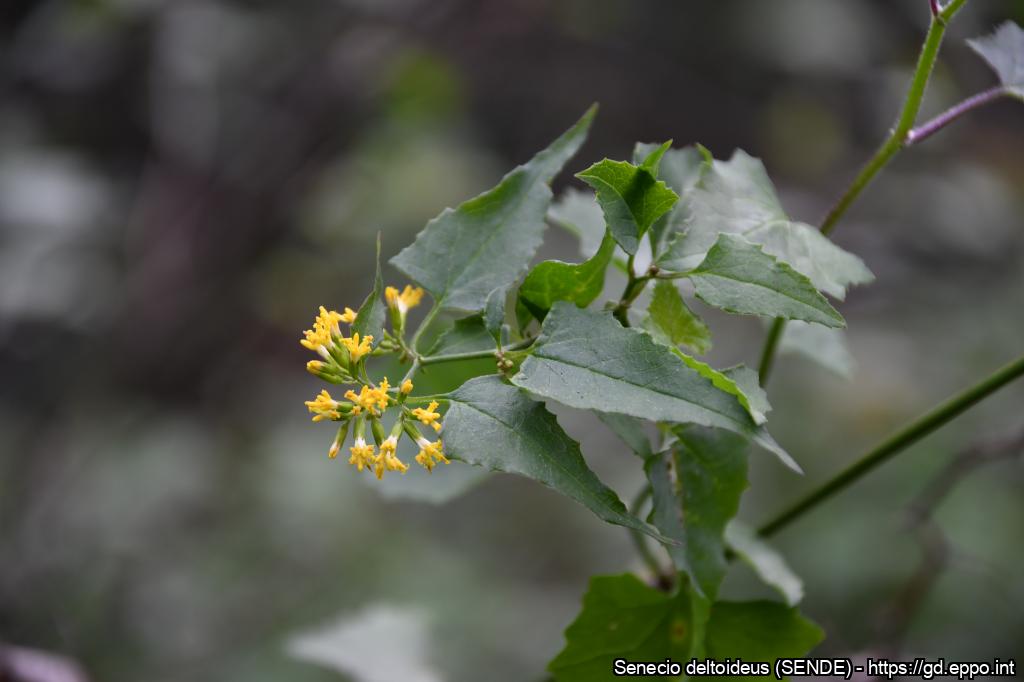
Senecio deltoideus plant
Courtesy: G.Fried
Why
Senecio deltoideus (Asteraceae) is recorded as an established species in the EPPO region where it can form dense stands which can negatively impact biodiversity and ecosystem services. The EPPO Panel on Invasive Alien Plants are seeking further information on any additional occurrences of S. deltoideus the EPPO region.
Geographical distribution
EPPO region: France, Italy, Spain
Africa: Eswatini, Kenya, Lesotho, Malawi, Mozambique, South Africa, United Republic of Tanzania, Zimbabwe
Morphology
Stems are generally smooth but may be sparsely hairy with fine hairs in some specimens. Leaves are broadly spear-shaped to narrowly triangular, up to 100 mm long and 50 mm wide, but often much smaller, generally without hairs, or the lower surface with fine hairs. Leaf margins are irregularly toothed. Flower heads are grouped in small or large clusters and can be with or without ray florets. Flower heads generally have 1-4 ray florets.
Biology and Ecology
Senecio deltoideus is a vigorous perennial climbing herb with zigzag branching which flowers during the winter months in the EPPO region (December to March).
Habitats
In the native range (in eastern and southern Africa), S. deltoideus is a species of open terrain, such as bracken and scrub land or found in montane grassland. In the EPPO region, it grows mainly in open vegetation, in Mediterranean grassland and shrubs and in forest clearings.
Pathways for movement
Plants for planting: S. deltoideus is traded as a garden ornamental plant in the EPPO region. The species can potentially be misidentified in trade for other similar looking species (e.g. Delairea odorata (Asteraceae, EPPO List of Invasive Alien Plants), Senecio angulatus (EPPO List of Invasive Alien Plants), S. macroglossus and S. tamoides). Plant material can be discarded as garden waste. Natural spread is by wind dispersed seed and spread from stems that can be broken and fragmented – these fragments leading to new viable plants and new populations.
Impacts
Senecio deltoideus can form dense mats smothering native plants and reducing regeneration. It can compete with native species by reducing light availability for species on the ground. Senecio species in general are known to be toxic to livestock and humans.
Control
Management measures have been evaluated in protected areas in the EPPO region, where natural-herbicide products, flame-weeding, mulching and mowing were all shown to be effective when repeated during and between seasons.
Sources
Fried G (2010) Prioritization of potential invasive alien plants in France. In: Proceedings of the 2nd International workshop on invasive plants in the Mediterranean type regions of the world. pp. 120-134. EPPO, Trabzon, Turkey.
Iamonico D (2017) Alien taxa of the tribe Senecioneae (Asteraceae) in Italy: a nomenclatural synopsis. Hacquetia, 16, 281-292.
Minuto L, Casazza G, Dagnino D, Guerrina M, Macri C, Mariotti MG (2021) Management of an invasive plant in a mediterranean protected area: the experience of Senecio deltoideus in Italy. Annali di Botanica, 2020, 11, 1-12. ff10.13133/2239-3129/16852
EPPO RS 2026/050
Entry date 2026-02