
Webinar on the EPPO Jens-Georg Unger Fellowship
Teleconference, 2026-04-17
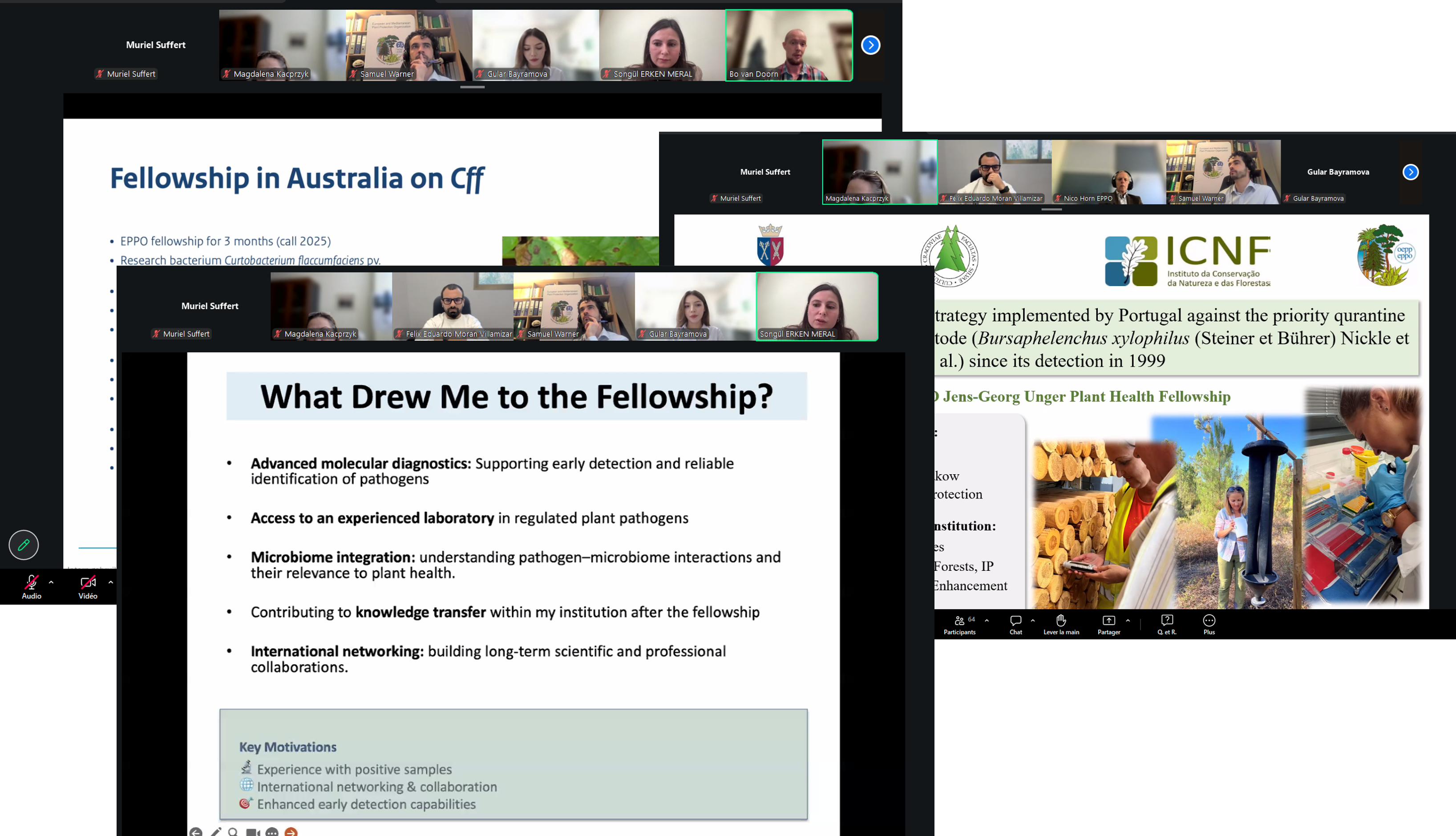
Screenshots from the webinar
As part of the celebrations for EPPO 75th anniversary a commemorative webinar was held to celebrate the success of the EPPO Jens-Georg Unger Plant Health Fellowship. The Fellowship started in 2020 with the purpose of enabling plant health professionals from the EPPO region to gain international working experience in plant health in another country or organisation through a secondment. More information on the fellowship can be found here.
The webinar was attended by more than 60 participants from 26 countries, including 24 EPPO member countries. The international audience demonstrated the high level of interest in the fellowship.
The webinar included a short overview of the fellowship followed by short talks from 3 past fellows on their experiences, as well as from 2 current fellows on their plans for their fellowship. There was time for questions during the webinar, where participants asked fellows about their experiences.
It was also announced that the call for the 2026 fellowship has now been opened. Applicants can apply for the 2026 fellowship before the deadline on 15th September 2026.
The EPPO Secretariat warmly thanks all attendees for their active participation during the webinar, and to fellows who kindly shared their experiences with the audience.
Summaries, presentations and the full video are available below.
Watch the recording of the webinar
Click on the image to watch the webinar recording on YouTube.
Presentations
The webinar included the following presentations which can be accessed through the links below.
|
Presentation from the EPPO Secretariat A presentation on the fellowship, including details of how to apply for the 2026 EPPO Jens-Georg Unger Fellowship. |
|
Mr Félix Morán Villamizar (IVIA, Valencia, Spain) Mr Morán Villamizar presented his experience from the fellowship where he worked on the evaluation and application of High-Throughput Sequencing techniques in diagnostics: a comparative study of Oxford Nanopore and Illumina technologies at the Plant Health Laboratory, ANSES, Angers, France. |
|
Ms Gular Bayramova (Azerbaijan Food Safety Institute, Baku, Azerbaijan) Ms Bayramova described her fellowship where she worked on seed transmission of tomato spotted wilt virus (TSWV) in pepper and tomato seeds at the Leibniz İnstitute DSMZ, Braunschweig, Germany. |
|
Ms Kacprzyk provided details of her experiences. She studied the prevention and control strategy implemented by Portugal against the pine wood nematode since its detection in 1999 at the Instituto de Conservação da Natureza e das Florestas, Lisboa, Portugal. |
|
Ms Songül Erken Meral (Black Sea Agricultural Research Institute, Türkiye) Ms Erken Meral presented her upcoming fellowship, where she plans to work on the development and application of molecular diagnostic methods for regulated and emerging bacterial pathogens (Xylella fastidiosa and Pseudomonas syringae pv. actinidiae) at the Instituto Pedro Nunes, Portugal. |
|
Mr Barendinus van Doorn (NVWA, Netherlands) Mr van Doorn detailed his plans for his fellowship, where he is working on developing a sampling protocol for the early detection of Curtobacterium flaccumfaciens pv. flaccumfaciens in latently infected (asymptomatic) mung bean plants and associated weeds at University of Queensland, Australia. |
Related Information
- Read more about the EPPO Jens-Georg Unger Fellowship

- View past fellowship awardees
- View testimony from Félix Morán, a 2024 Fellow
- View testimony from Nathan Hayes, a 2024 Fellow