

Network of experts working on surveillance, monitoring, and control
of the emerald ash borer, Agrilus planipennis
In October 2022, the EPPO Panel on Quarantine Pests for Forestry decided to establish a network of experts working on surveillance, monitoring, and control of Agrilus planipennis (Coleoptera: Buprestidae – emerald ash borer).
This network was established in association with an EPPO-EU project (Grant agreement SANTE/2020/G1/EPPO/SI2.823766).
In December 2024, EPPO held a webinar
‘Emerald ash borer (Agrilus planipennis) in the EPPO region:
Preparedness of countries for its further spread’.
In April 2026, EPPO FAO-REUFIS BFW organised a joint conference titled
‘Safeguarding Forests in Europe:
Emerging Risks of Agrilus Wood Borers (Buprestidae)’ .

Adult – Courtesy: Eduard Jendek

Larva– Courtesy: Eduard Jendek

Exit hole – Courtesy: Eduard Jendek

Trap – Courtesy: Dominic Eyre
Objective and scope of the network
The objective of this network is to exchange data on monitoring and to get a better understanding of the current distribution and spread of A. planipennis in the EPPO region. Moreover, information on effective trapping and management options could be shared.
The network will focus on the EPPO region, however members from other regions are also welcome as significant knowledge on the pest biology, as well as experience on monitoring and control have been gathered in other parts of the world.
How the network will function
At the initial stage, the network will function as an email list maintained by the EPPO Secretariat, who will accumulate new information (monitoring, distribution, trapping, and management data), including that sent by the members of the network. The EPPO Secretariat will then regularly (normally once a month) send the accumulated information to the members of the network through the email list. Once a sufficient coverage has been obtained, a teleconference will be organized to discuss the current situation and plan further work. It is also planned to publish on this webpage, the most important news that have been gathered by the network.
How to participate in the network
The EPPO Secretariat invites National Plant Protection Organizations (NPPOs), researchers, and practitioners to subscribe to the email list via the following link (your registered email address will not be disclosed).
Subscribe here: https://forms.office.com/e/7GxvJkS0YT 
Contact point
Members of the network are invited to send relevant information on monitoring, distribution, trapping, and management of A. planipennis to Dmitrii Musolin (EPPO Scientific Officer) who will compile and distribute it through the mailing list.
Please contact us through our contact page here.
EPPO dynamic map of distribution of Agrilus planipennis
With the assistance of the Network, EPPO has developed a tool, DynaMaps, which creates interactive, dynamic maps showing the presence of the pest by region and year. This tool will be continuously updated as new data become available. The A. planipennis DynaMaps is now available online.

Currently, there are approximately 4 900 records of A. planipennis from its native (China, South Korea, Japan) and invasive ranges (North America, the Russian Federation, Ukraine, Belarus, Hungary, and Slovakia). The records are taken from peer-reviewed scientific publications, NPPO reports, and open databases. Experts from the Network and the EPPO Panel on Quarantine Pests for Forestry collect and review old publications and monitor newly published records. They verify records of presence of A. planipennis based on their expertise and prepare datasets to be used in the dynamic map. NPPOs of relevant EPPO countries are invited to validate the prepared datasets. Belarus, Hungary, and Slovakia have validated the relevant records, the Russian Federation and Ukraine have not yet responded.
On the map, records can be seen as individual points or clusters. It is possible to add country borders and Köppen-Geiger climate types and download resulting maps. There are options to display the records of particular time periods and to make an animation demonstrating changes of spread over years. In future, it will be possible to add layers for host plants, data on traps, and measure distance and area.
The public map with validated records in the EPPO region is available at: https://dynamap.eppo.int/public/01a120f9-f213-73a6-995b-845068879de0
NPPOs of EPPO member countries have been invited to access an extended map that also includes records which have not been validated. Access to this map is restricted to NPPOs of EPPO member countries.

Newsletters of the Network
2023
2024
- Newsletter # 4 (March 2024)

- Newsletter # 5 (June 2024)
- Newsletter # 6 (September 2024)
- Newsletter # 7 (December 2024)
2025
2026
Useful links
EPPO Standards and documents on Agrilus planipennis
- EPPO Standards. Phytosanitary procedures. PM 3/87 (1) Monitoring and consignment inspection of wood chips, hogwood and bark for quarantine pests [2019]
- EPPO Standards. Diagnostics. PM 7/154(1) Agrilus planipennis [2023]
- EPPO Standards. Commodity-specific phytosanitary measures. PM 8/11 (1) Fraxinus [2020]
- EPPO Standards. National regulatory control systems. PM 9/14 (1) Agrilus planipennis: procedures for official control [2013]
- EPPO Pest Risk Analysis for Agrilus planipennis [2013]
- EPPO Datasheet on Agrilus planipennis [revised in 2021]
- EPPO Reporting Service articles on Agrilus planipennis
- EPPO Poster on Agrilus planipennis [template poster, PowerPoint file]
EPPO links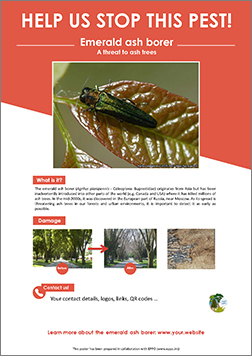
- EPPO Global Database
- EPPO Platform on PRAs (PRA documents)
- EPPO-Q-Bank (specimens and sequences)
- EPPO Platform on Communication Material (search the platform by organism, select Agrilus planipennis)
Other links of special interest
-
Page for Agrilus planipennis in the Euphresco Digital Research Object Portal (DROP)
- European Food Safety Agency (EFSA) Pest survey card on Agrilus planipennis
- CABI datasheet for Agrilus planipennis (emerald ash borer)
- Global Biodiversity Information Facility (GBIF) datasheet for Agrilus planipennis
- iNaturalist page for Agrilus planipennis
- The International Plant Sentinel Network (IPSN): Emerald Ash Borer monitoring in Eastern Europe
-
Observatree: Monitoring Tree Health Project (UK): Useful information materials on A. planipennis
Received References
All received references to recently published papers on A. planipennis are included in the Newsletters of the Network with short abstracts and links.